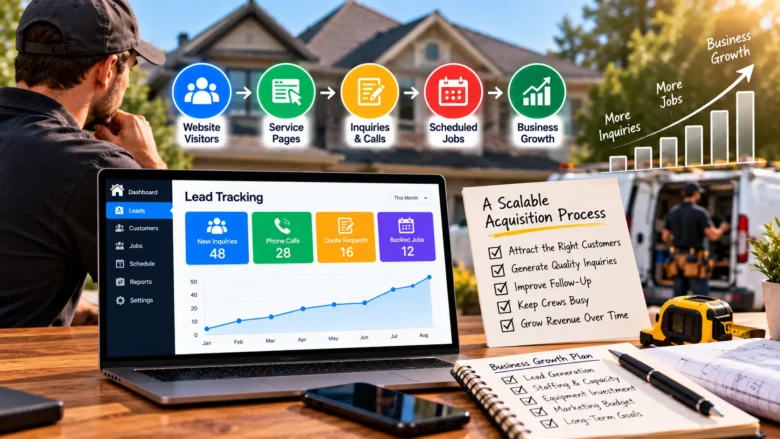
Growing a home service company involves more than doing good work and keeping customers happy. At some point, an owner has to decide whether the business can support another technician, invest in equipment, take on larger projects, or expand into another service area.
Those decisions become difficult when new customer inquiries are unpredictable.
A contractor may have a full schedule for several weeks and then suddenly face a quieter period. That uncertainty affects more than sales. It can influence hiring, equipment purchases, cash flow, scheduling, and the owner’s willingness to take on additional overhead.
Consistent lead generation does not guarantee a certain number of customers or a particular level of revenue. What it can provide is a more structured way to create and measure opportunities, giving the business better information for making growth decisions.
Growth Becomes Difficult When Demand Is Unpredictable
Many small contractors begin with a simple customer acquisition model: do excellent work, ask satisfied customers for referrals, and wait for the phone to ring.
That approach can work for a small operation, particularly when the owner has a strong local reputation. The difficulty appears when the business wants to grow.
Referrals are difficult to forecast. One month may bring several recommendations, while another may produce very few. The same applies to occasional advertising. Turning marketing on only when the schedule becomes empty can create a cycle of reacting to slow periods rather than planning for growth.
An owner considering another employee needs to know whether there is enough work to keep that person productive. A company thinking about financing a new vehicle needs confidence that the additional capacity will be useful. A contractor considering a larger shop has to think about whether future demand can support the added expense.
None of these decisions can be answered by lead generation alone, but a more consistent flow of opportunities can provide useful information for making them.
Lead Flow Affects More Than the Sales Pipeline
Customer inquiries are closely connected to operations.
Consider a plumbing company that receives far more calls than its technicians can handle. The immediate problem is not a lack of demand. It may be scheduling capacity, staffing, or the need to prioritize certain types of jobs.
Now consider the opposite situation: the company has technicians available but receives too few suitable inquiries. The problem may be customer acquisition rather than operations.
This relationship is important because growth requires balance.
Hiring too early can increase fixed costs before demand supports them. Hiring too late can leave the company unable to respond when demand increases. Purchasing equipment can improve capacity, but only if there is enough appropriate work to justify the investment.
A predictable customer acquisition process gives owners another business variable they can monitor alongside revenue, expenses, utilization, and cash flow.
Think About Customer Acquisition as a Business System
A scalable acquisition process does not need to be complicated.
At its foundation, it should answer a few basic questions:
Who are we trying to attract?
Which services do we want to grow?
Where are potential customers likely to find us?
How can they make contact?
What happens after they contact us?
How do we know which opportunities are becoming actual business?
For example, a roofing contractor may decide to focus on replacement projects rather than small repairs. A landscaping company may want more recurring maintenance customers. An electrical contractor might want to increase demand for a particular service while continuing to accept other work.
Businesses exploring additional customer acquisition options can also review Home Pro Leads while defining the types of customers and services that fit their growth plans.
The important point is that the acquisition process should support the business model rather than operate separately from it.
Connect Marketing Activity With Business Capacity
Marketing decisions should take the company’s ability to deliver the service into account.
Suppose a renovation company has enough staff to handle five additional projects per month. Its marketing strategy should not be evaluated simply on whether it can generate hundreds of inquiries. The more useful question is whether it can generate a manageable number of relevant opportunities that fit the company’s capacity.
The same principle applies to seasonal businesses.
A landscaper may need to prepare for a surge in spring demand. An HVAC company may experience different patterns between heating and cooling services. A painter may have periods when exterior work is more practical and other periods when interior projects become more relevant.
Planning marketing around operational capacity can help avoid unnecessary pressure on the business.
It also creates an opportunity to identify services that can be promoted during slower periods, helping the company make better use of available staff and equipment.
Track the Metrics That Actually Matter
A business does not need hundreds of marketing metrics to understand whether customer acquisition is working.
The most useful numbers are usually connected to actual business activity.
Depending on the company, these might include:
- Number of new inquiries
- Qualified opportunities
- Estimates or consultations
- Jobs booked
- Average job value
- Revenue by acquisition source
- Time between inquiry and sale
The purpose of tracking is not to create more administrative work. It is to identify patterns.
If one source generates many inquiries but very few suitable opportunities, the owner may want to reconsider how that source is being used. If another produces fewer inquiries but more booked work, it may deserve greater attention.
The business can also compare customer acquisition costs with the revenue generated by those customers.
The U.S. Small Business Administration recommends that small businesses develop marketing plans with defined target markets, sales goals, marketing actions, budgets, and methods for measuring results. Its guidance also emphasizes comparing marketing costs with the revenue they generate and updating the plan as circumstances change. SBA guidance on managing marketing and sales
For a growing contractor, this turns marketing from an occasional expense into something that can be evaluated as part of the wider business plan.
When It Makes Sense to Get Outside Lead Generation Support
There is a point where the owner of a growing service business may simply have too many responsibilities.
Running crews, estimating projects, purchasing materials, handling customers, managing employees, dealing with suppliers, and overseeing finances can leave little time for maintaining a consistent acquisition process.
At that stage, outsourcing some customer acquisition activities may be worth considering.
A contractor evaluating a managed lead generation system should look beyond the promise of receiving more inquiries. The more important questions are whether the approach fits the company’s target customers, service area, capacity, follow-up process, and growth objectives.
External support should fit into the company’s existing operation.
If a business receives inquiries but cannot respond promptly, the acquisition problem has not really been solved. Likewise, if the inquiries do not match the services or locations the company can handle, higher lead volume may simply create more administrative work.
The objective should be to create a process that the business can realistically manage.
Build a System That Can Adapt as the Company Grows
A customer acquisition process does not have to remain the same forever.
A contractor with three employees may manage leads very differently from a company with several crews, multiple service areas, and dedicated office staff.
As the business expands, the process can become more structured.
Lead sources can be separated and measured. Customer inquiries can be assigned to specific employees. Follow-up can be documented. Marketing budgets can be adjusted based on actual results. Service areas can be expanded when capacity allows.
The underlying principle remains the same: customer acquisition should be connected to business planning.
That connection becomes particularly important when making larger decisions. If an owner wants to hire another technician, open another location, purchase expensive equipment, or increase advertising spend, understanding the current flow of opportunities provides useful context.
Consistency Creates Better Information for Business Decisions
Consistent lead generation should not be confused with guaranteed sales.
Customer demand will always fluctuate. Markets change, seasons affect home improvement work, competitors enter markets, and individual projects can vary considerably in size.
The value of a repeatable acquisition process is that it gives the business something it can observe and improve.
Instead of asking, “Where will our next customer come from?” every time the schedule becomes quiet, the owner can look at the systems already in place and identify where opportunities are being generated, which ones are suitable, and where prospects are being lost.
For a home service entrepreneur, that information has value beyond marketing.
It can influence staffing decisions, scheduling, equipment planning, budgeting, and the pace at which the company takes on additional overhead.
A growing contractor does not need perfect predictability. What matters is building enough structure around customer acquisition that growth decisions are based on more than hope, referrals, or last month’s workload.
That is the real business case for treating lead generation as an ongoing operating system rather than an activity that only starts when the phone stops ringing.